The 15 Words That Give Away AI Writing, According to a 50-Sample Study

Somewhere around 74 percent of new web pages published today include AI-generated content. That figure comes from an Ahrefs analysis of 900,000 pages, and it explains why so many editors now run a scan before hitting publish, not because AI writing is inherently bad, but because it has a specific texture that readers, and Google, are getting better at noticing.
A recent study by Phrasly ran 50 real pieces of content, blog posts, LinkedIn posts, academic theses, and web pages, through an AI detector to find out exactly which words and sentence patterns keep triggering the flag. The full breakdown, 15 Common AI Phrases Flagged by AI Detectors, is worth reading directly, but the short version is that the tells are more specific and more format-dependent than most writing advice accounts for.
What the study actually measured
The methodology was narrower than it sounds, and that narrowness is part of what makes the findings useful. Researchers pulled content created or updated between 2024 and 2026, ran it through the detector, and kept only the samples that scored above zero on the AI-generated scale. Fully human-scoring content was excluded from the analysis, so this is really a picture of what already-flagged writing has in common, not a picture of writing in general.
Each sample got logged for word count, AI-generated percentage, sentences flagged, and specific phrases highlighted. That last variable matters more than it sounds. Some samples got flagged with zero highlighted phrases, meaning the detector picked up on statistical rhythm rather than any particular word choice. Others had clear phrase-level tells the detector could point to directly, which is where the top 15 list comes from.
The four words that would not stop showing up
Landscape, the frictionless-promise word discussed below, foster, and the rule-of-three construction, not just X but also Y, dominated the list across all four content types. That cross-format consistency is the interesting part. A phrase that only shows up in one genre is a genre habit. A phrase that shows up in blog posts, LinkedIn captions, academic theses, and web copy alike is closer to a default the underlying language models fall back on regardless of what they are writing.
Two multi-word phrases stood out even more than the single words. One of the most appeared more than any other multi-word phrase in the entire corpus, more than 11 times across the 50 samples. Paired with it is important to, these two filler constructions alone accounted for more than a quarter of all the repeated AI-style phrasing researchers found.
Two commonly flagged phrases did not make the final list on purpose. For example and such as showed up frequently too, 61 and 15 times respectively, but the researchers excluded them because they read as generic, unremarkable writing rather than anything distinctly AI. That distinction is worth sitting with. Not every repeated phrase is actually a tell. Some of them are just common English that any writer, human or machine, reaches for constantly.
Why the same content type keeps producing the same tell
The most useful part of the study is not the overall top 15. It is how the specific pattern shifts depending on what is actually being written. Blog posts leaned hardest on the rule-of-three construction, showing up in more than a third of the sample. Academic theses went a different direction entirely, defaulting to foster and the conclusive ultimately, a more formal register that matches the genre. LinkedIn posts had their own tell: the direct-address hook, whether you, opening a striking share of the flagged posts. Web copy defaulted to one reassuring word almost every time, promising a frictionless experience over and over.
That clustering matters for anyone editing AI-assisted writing, because it means a universal banned-word list will not actually solve the problem. A thesis that carefully avoids foster but still opens every paragraph with whether you has not fixed anything. The tell just moved to wherever the model's genre-specific habits happen to be strongest for that particular kind of writing.
The length myth the data quietly puts to rest
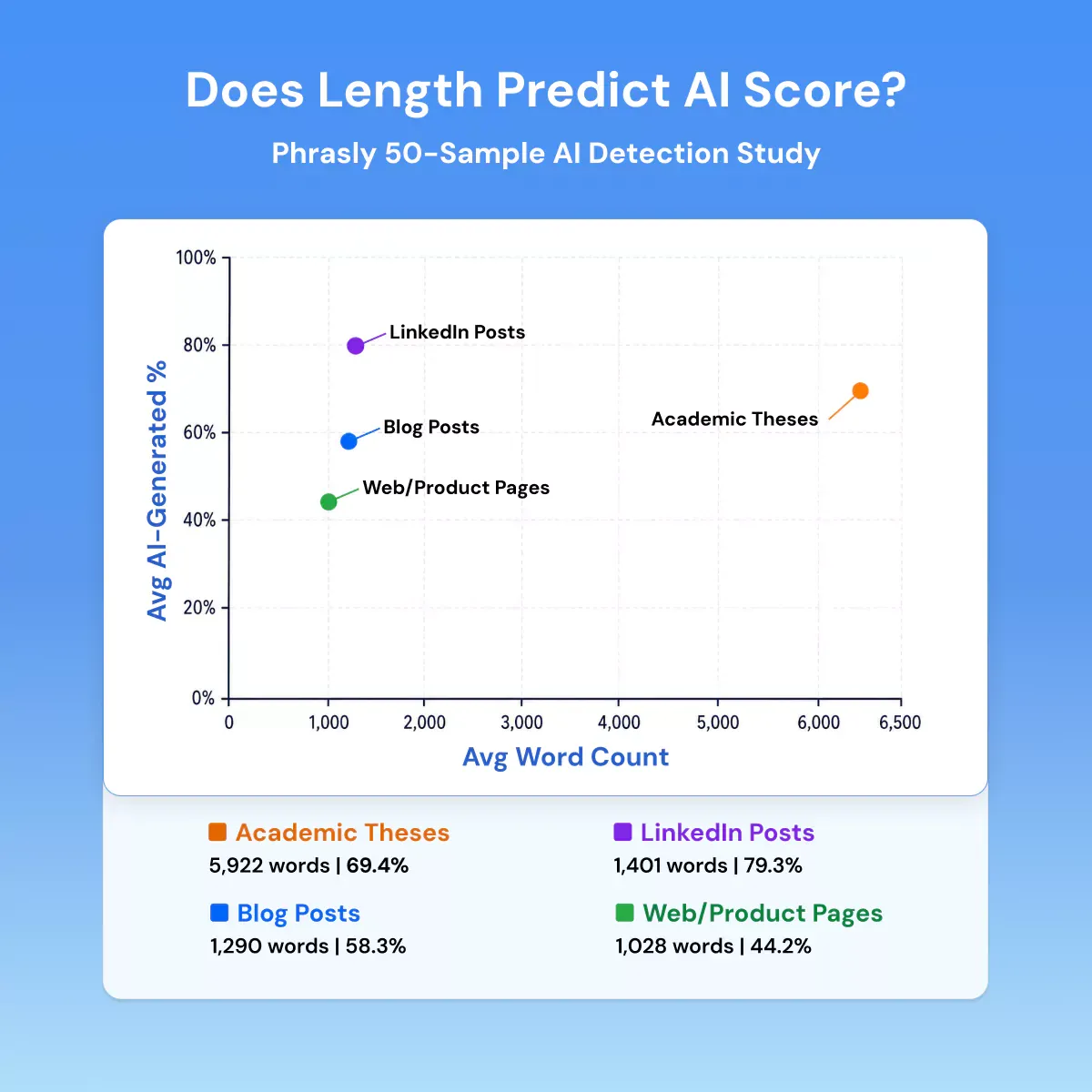
One assumption the researchers tested directly and found false: that longer, more complex writing would score lower on AI detection than short, punchy copy. It does not work that way at all. Length had almost no relationship to the detection score. Some of the shortest LinkedIn posts in the sample scored a full 100 percent AI-generated, while academic theses running several thousand words were flagged just as often.

Source: Phrasly, Does Length Predict AI Score?
Academic theses averaged 5,922 words and still scored 69.4 percent AI-generated on average. Web and product pages, at barely over a thousand words, came in noticeably lower at 44.2 percent. What predicted the score was not length. It was pattern density, meaning how concentrated the tell-tale phrases and rhythms were, not how many words the writer had available to dilute them.
LinkedIn posts specifically scored nearly twice as high on average as marketing web pages, despite web copy being written to persuade and LinkedIn captions being written to sound personal. LinkedIn was also the only format where the median score reached 100 percent, meaning at least half the sampled posts were fully flagged. Short-form, casual-register writing is not automatically safer than longer, formal writing when it comes to detection, and the intuition that it would be turns out to be backwards.
What to actually do with this once you spot it in your own writing
Knowing the specific phrases only helps if it changes how you edit. The study's own before-and-after examples are a reasonable model to work from. A blog sentence like AI writing tools are not just faster, but also more consistent, and ultimately more scalable gets rebuilt into three separate, differently-shaped sentences that vary in length and actually commit to an opinion instead of hedging through a triple construction. A LinkedIn opener like whether you are a founder or a freelancer, you need to understand this one shift becomes a specific, personal anecdote instead of a generic direct-address hook.
The pattern in both fixes is the same: replace an abstract, structurally predictable sentence with something concrete and specific to the actual content. That is harder than swapping one word for a synonym, but it is also the only fix that survives contact with a detector that measures statistical rhythm rather than scanning for a list of banned words.
It is also worth remembering that detection tools are not perfectly precise instruments. They are notorious for false positives, flagging genuinely human writing simply because it happens to follow predictable patterns. Before treating any single score as a final verdict on a piece, understanding how AI detector false positives happen is worth the ten minutes it takes, since a flagged score and a genuinely AI-written piece are not always the same thing.
The predictable tell
What this study adds to the broader conversation about AI writing is specificity. Not a vague sense that AI sounds generic, but which specific words, which specific sentence shapes, and which specific genres are most exposed to which specific tells. Landscape, foster, the frictionless-promise word web copy defaults to, and the rule-of-three construction are not going away as language model habits any time soon, which means knowing them by name is a genuinely useful editing shortcut rather than a vague style note.
The data also clears up a persistent myth on its own terms. Length does not protect a piece of writing, and complexity does not either. A six-thousand-word thesis can score just as high as a two-hundred-word LinkedIn post. What separates writing that reads as human from writing that reads as machine-generated is not how much of it there is. It is whether the specific sentences, phrase by phrase, commit to something concrete instead of falling back on the same dozen safe constructions every model reaches for by default.
- Like
- Reply
-
Share




About Us · User Accounts and Benefits · Privacy Policy · Management Center · FAQs
© 2026 MolecularCloud