Testing for Heavy Metals in Biodegradable Plastics

I. Overview of the Protocol
This protocol utilizes the Macylab AA-1800H flame/graphite furnace atomic absorption spectrophotometer to analyze biodegradable plastics (including PLA, PBAT, starch-based plastics, etc.). in accordance with Iranian Standard INSO 23403 “Biodegradable Plastics—Requirements and Test Methods” (equivalent to EU Standard EN 13432). It determines the content of heavy metals such as cadmium (Cd) and mercury (Hg), ensuring compliance with the standard limits of Cd ≤ 0.5 mg/kg and Hg ≤ 0.5 mg/kg. This method is suitable for raw material inspection, finished product quality control, and export compliance testing.
II. Implementation Standards
· INSO 23403 “Biodegradable Plastics—Requirements and Test Methods”
· EN 13432 “Compostable Plastics for Packaging—Testing and Acceptance Requirements”
· GB/T 35657 General Method for Microwave Digestion of Solid Samples
· General Principles of Atomic Absorption Spectroscopy
· EN 13432 “Compostable Plastics for Packaging—Testing and Acceptance Requirements”
· GB/T 35657 General Method for Microwave Digestion of Solid Samples
· General Principles of Atomic Absorption Spectroscopy
III. Instruments and Equipment
AA-1800H Flame/Graphite Furnace Atomic Absorption Spectrophotometer
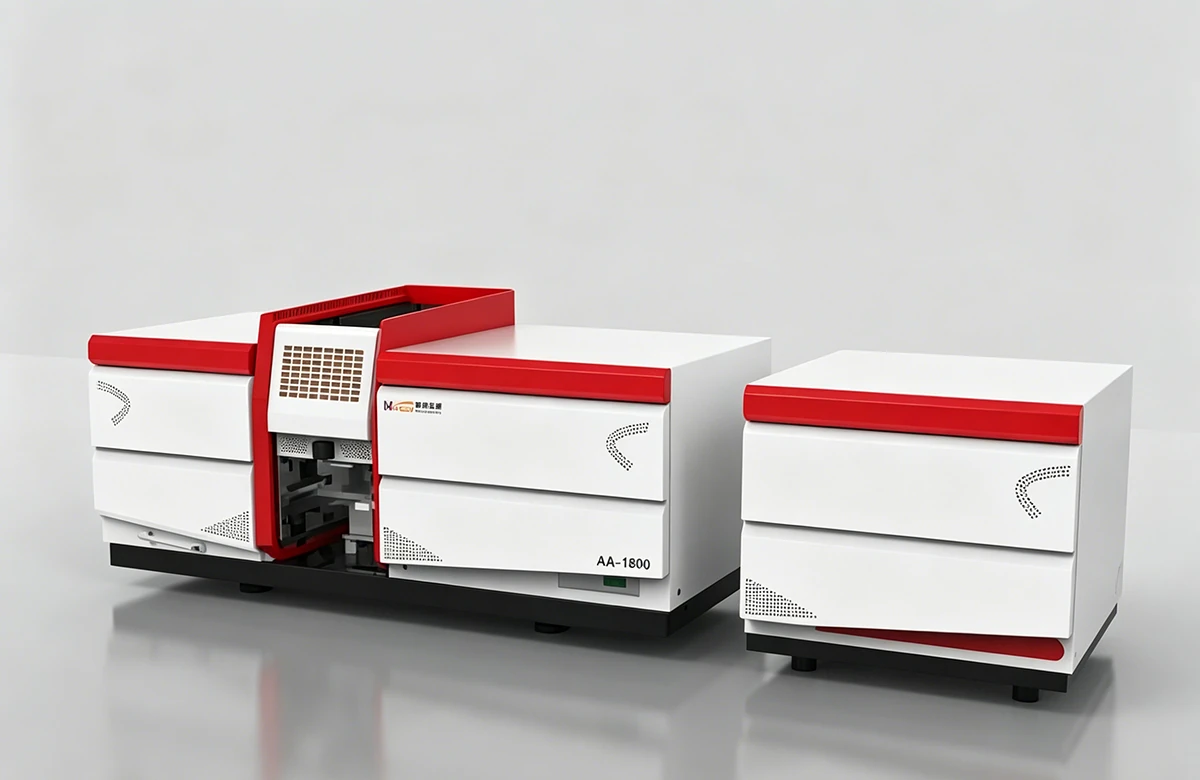
Automatic switching between six lamp positions, fully automatic collimation
Large-area grating with 1,800 lines/mm, wavelength range 190–900 nm
Graphite furnace temperature range: ambient to 3,000°C, 20-step programmed temperature ramp
Cd characteristic concentration: 0.5×10⁻¹² g, detection limit: 0.4×10⁻¹² g
Large-area grating with 1,800 lines/mm, wavelength range 190–900 nm
Graphite furnace temperature range: ambient to 3,000°C, 20-step programmed temperature ramp
Cd characteristic concentration: 0.5×10⁻¹² g, detection limit: 0.4×10⁻¹² g
Supporting Equipment
Microwave digestion system
Ultrapure water system (18.2 MΩ·cm)
Analytical balance (0.1 mg)
PTFE digestion vessels, volumetric flasks, pipettes, etc.
Ultrapure water system (18.2 MΩ·cm)
Analytical balance (0.1 mg)
PTFE digestion vessels, volumetric flasks, pipettes, etc.
IV. Reagents
Analytical-grade HNO₃, H₂O₂
Cd and Hg standard solutions (1000 mg/L)
High-purity argon (≥99.999%)
Ultrapure water (Grade 1)
Cd and Hg standard solutions (1000 mg/L)
High-purity argon (≥99.999%)
Ultrapure water (Grade 1)
V. Sample Preparation (Microwave Digestion)
Sample pretreatment: Cut the plastic into small pieces → grind in liquid nitrogen → pass through a 80-mesh sieve and mix thoroughly.
Weighing: Place 0.2–0.5 g (accurate to 0.0001 g) into a digestion vessel.
Digestion: Add 6 mL HNO₃ + 2 mL H₂O₂, let stand for 30 min, seal, and perform microwave digestion.
Digestion Program:
120°C for 5 min → 160°C for 5 min → 190°C for 15 min
After cooling, evaporate the acid to near dryness at 120°C, dilute to 25 mL with ultrapure water, and perform a blank test throughout the process.
Weighing: Place 0.2–0.5 g (accurate to 0.0001 g) into a digestion vessel.
Digestion: Add 6 mL HNO₃ + 2 mL H₂O₂, let stand for 30 min, seal, and perform microwave digestion.
Digestion Program:
120°C for 5 min → 160°C for 5 min → 190°C for 15 min
After cooling, evaporate the acid to near dryness at 120°C, dilute to 25 mL with ultrapure water, and perform a blank test throughout the process.
VI. Instrumental Analysis Conditions (AA-1800H)
1) Cadmium (Cd, Graphite Furnace Method)
· Wavelength: 228.8 nm
· Lamp current: 4 mA
· Spectral bandwidth: 0.4 nm
· Background correction: Deuterium lamp + self-absorption
· Graphite furnace program:
o Drying: 110°C for 30 s
o Ashing: 350°C for 20 s
o Atomization: 1800°C for 5 s
o Purification: 2000°C for 3 s
· Calibration curve: 0, 0.1, 0.2, 0.5, 1.0 μg/L, r ≥ 0.9995
· Limit: ≤0.5 mg/kg (pass)
2) Mercury (Hg, hydride generation AAS)
· Wavelength: 253.7 nm
· Lamp current: 3 mA
· Carrier gas: Argon, flow rate 200 mL/min
· Reducing agent: 1% NaBH₄ + 0.5% NaOH
· Calibration curve: 0, 0.1, 0.2, 0.5, 1.0 μg/L, r ≥ 0.999
· Limit: ≤0.5 mg/kg (Pass)
· Wavelength: 228.8 nm
· Lamp current: 4 mA
· Spectral bandwidth: 0.4 nm
· Background correction: Deuterium lamp + self-absorption
· Graphite furnace program:
o Drying: 110°C for 30 s
o Ashing: 350°C for 20 s
o Atomization: 1800°C for 5 s
o Purification: 2000°C for 3 s
· Calibration curve: 0, 0.1, 0.2, 0.5, 1.0 μg/L, r ≥ 0.9995
· Limit: ≤0.5 mg/kg (pass)
2) Mercury (Hg, hydride generation AAS)
· Wavelength: 253.7 nm
· Lamp current: 3 mA
· Carrier gas: Argon, flow rate 200 mL/min
· Reducing agent: 1% NaBH₄ + 0.5% NaOH
· Calibration curve: 0, 0.1, 0.2, 0.5, 1.0 μg/L, r ≥ 0.999
· Limit: ≤0.5 mg/kg (Pass)
VII. Testing Procedure
1. Turn on the instrument and allow it to warm up for 30 minutes; ensure the flame/graphite furnace is ready.
2. Establish standard curves for Cd and Hg, and verify linearity and stability.
3. Test in the following order: blank → standard points → sample solution → duplicate sample.
4. The instrument automatically calculates the concentration: (\text{Element concentration (mg/kg)}=\frac{C\times V}{m}) where C is the concentration at injection (μg/L); V is the final volume (mL); and m is the sample weight (g).
2. Establish standard curves for Cd and Hg, and verify linearity and stability.
3. Test in the following order: blank → standard points → sample solution → duplicate sample.
4. The instrument automatically calculates the concentration: (\text{Element concentration (mg/kg)}=\frac{C\times V}{m}) where C is the concentration at injection (μg/L); V is the final volume (mL); and m is the sample weight (g).
VIII. Result Interpretation
Cd ≤ 0.5 mg/kg, Hg ≤ 0.5 mg/kg: Complies with ISO 23403 / EN 13432
If either element exceeds the limit: Deemed non-compliant
If either element exceeds the limit: Deemed non-compliant
IX. Advantages of the Solution (Macylab AA-1800H)
· Ultra-high sensitivity of the graphite furnace easily meets the 0.5 mg/kg limit
· Six-lamp automatic switching with one-button switching between Cd and Hg for high efficiency
· Dual background suppression (deuterium lamp + self-absorption) provides strong resistance to interference from plastic matrices
· System stability with RSD ≤ 3%, suitable for long-term quality control
· Six-lamp automatic switching with one-button switching between Cd and Hg for high efficiency
· Dual background suppression (deuterium lamp + self-absorption) provides strong resistance to interference from plastic matrices
· System stability with RSD ≤ 3%, suitable for long-term quality control
X. Precautions
Hg is highly volatile; digestion/acid removal temperature ≤ 120°C to prevent loss.
Soak all vessels in dilute nitric acid throughout the process to strictly prevent contamination.
Prepare standard solutions immediately before use to ensure data reliability.
Soak all vessels in dilute nitric acid throughout the process to strictly prevent contamination.
Prepare standard solutions immediately before use to ensure data reliability.
- Like
- Reply
-
Share
Reply




About Us · User Accounts and Benefits · Privacy Policy · Management Center · FAQs
© 2026 MolecularCloud