SC-500 Exam Explained: Skills, Study Plan, and Preparation Guide for 2026

SC-500 Exam Preparation Guide: Skills, Study Strategy, And Key Security Areas
Preparing for the SC-500 exam requires more than memorizing Microsoft security terminology. The exam is designed around practical cloud and AI security responsibilities, so candidates benefit from understanding how identity, infrastructure, data, networking, compute, and security posture work together.
Microsoft currently lists SC-500 as a beta exam for the Microsoft Certified: Cloud and AI Security Engineer Associate certification. The current Microsoft study guide describes the exam as "Implementing End-to-End Security Controls for Cloud and AI Workloads." Since beta exam objectives can evolve, candidates should verify the latest information on Microsoft Learn before starting or finalizing their preparation.
This guide explains the main areas to study, how to organize preparation, and how to use practice questions responsibly.
What Does The SC-500 Exam Cover?
SC-500 focuses on implementing security controls across Microsoft cloud and AI workloads. The exam is intended for professionals who need to protect cloud and hybrid environments rather than simply understand security concepts at a theoretical level.
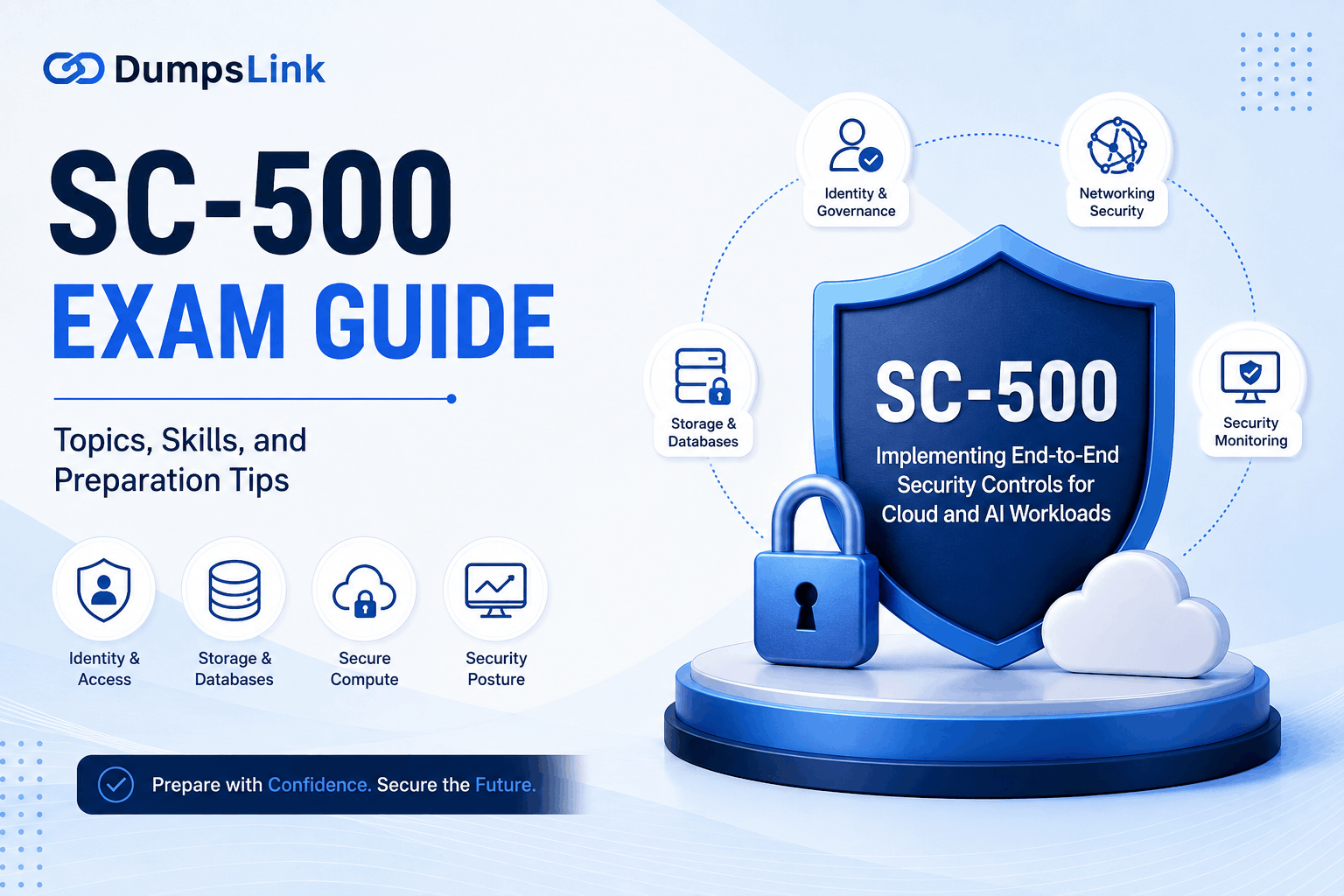
The current skills measured are organized into four domains:
✅ Manage identity, access, and governance
✅ Secure storage, databases, and networking
✅ Secure compute
✅ Manage and monitor security posture
These domains are closely connected. For example, securing an Azure workload may involve identity controls, network restrictions, protected secrets, resource configuration, and continuous monitoring at the same time.
That is why candidates should study the relationships between services instead of treating each topic as an isolated chapter.
Who Is SC-500 Designed For?
SC-500 is particularly relevant to security professionals working with Microsoft cloud and hybrid technologies.
The exam can be a logical fit for professionals who are involved in areas such as:
✅ Cloud security engineering
✅ Identity and access management
✅ Azure infrastructure security
✅ Security operations
✅ Security governance
✅ Data protection
✅ Application and workload security
✅ AI workload security
Microsoft recommends practical experience with Azure administration, including compute, networking, and storage. Familiarity with Microsoft Entra ID is also important.
Candidates who are completely new to Azure security may need additional foundational study before moving into the SC-500 objectives.
SC-500 Exam Domains Explained
Understanding the domain structure is one of the easiest ways to turn the exam objectives into a study plan.
Identity, Access, And Governance
The first domain focuses on controlling who or what can access cloud resources and under which conditions.
Important subjects include Microsoft Entra ID, Conditional Access, Privileged Identity Management, authentication methods, enterprise applications, app registrations, managed identities, and permissions.
Candidates should understand the security problem that each technology addresses.
For example, learning Conditional Access should involve more than remembering its definition. You should understand why an organization might require stronger authentication under particular conditions or restrict access based on security requirements.
The same principle applies to privileged access. Knowing that Privileged Identity Management exists is less useful than understanding why temporary or controlled administrative access can reduce unnecessary exposure.
Storage, Databases, And Networking
The storage, databases, and networking domain currently represents the largest percentage of the SC-500 exam according to Microsoft's study guide.
This area requires candidates to think about how data and resources are protected from unauthorized access.
Preparation should cover topics such as:
✅ Storage security
✅ Database protection
✅ Network access controls
✅ Private connectivity
✅ Segmentation
✅ Resource access
✅ Data protection
✅ Network security configurations
A practical way to study this domain is to consider a hypothetical Azure application.
Ask yourself:
Where is its data stored?
Who can access that data?
How does the application communicate with other resources?
Which network controls limit unnecessary access?
How should sensitive information be protected?
This approach turns individual services into a larger security architecture.
Compute Security
Cloud workloads still require security controls after they have been deployed.
The compute domain focuses on protecting workloads and the infrastructure supporting them.
Instead of studying compute security as a standalone subject, connect it with the other SC-500 domains.
For example, a secure workload may require:
✅ Appropriate identity controls
✅ Restricted network access
✅ Protected secrets
✅ Secure resource configurations
✅ Monitoring
✅ Continuous assessment of security posture
Thinking in this way can help candidates prepare for scenario-based questions where several technologies appear relevant.
Security Posture And Monitoring
The final domain focuses on maintaining security after resources are deployed.
Cloud environments change frequently. New resources are created, permissions change, configurations are modified, and applications evolve.
Security teams therefore need visibility into their environment and a way to identify potential weaknesses.
When preparing for this domain, focus on the difference between deploying a security control and continuously managing security posture.
That distinction is important because cloud security is not a one-time configuration exercise.
How To Build An SC-500 Study Plan
A good preparation plan should combine official documentation, practical learning, revision, and assessment.
Step 1: Start With The Current Microsoft Objectives
Do not begin with random practice questions.
First, review Microsoft's current SC-500 study guide and list each skill measured in the exam.
Create a simple checklist and mark topics as:
✅ Not started
✅ Studying
✅ Practiced
✅ Confident
This provides a clearer picture of your progress.
Step 2: Identify Your Weakest Domain
Not every candidate starts with the same level of knowledge.
Someone working primarily in identity security may already understand Microsoft Entra ID but have less experience with Azure networking.
Another candidate may have strong Azure infrastructure knowledge but need more time with governance and identity.
Identify the domain where your practical experience is weakest and allocate additional study time there.
Step 3: Learn The Purpose Behind Each Technology
Avoid studying Microsoft services as isolated definitions.
For every technology, ask:
✅ What security problem does it solve?
✅ What type of resource does it protect?
✅ Who or what interacts with it?
✅ What configuration decisions matter?
✅ What could happen if it were configured incorrectly?
These questions encourage understanding rather than memorization.
Step 4: Use Hands-On Practice
Hands-on experience is valuable for cloud security because many concepts become clearer when you actually configure or examine them.
Where appropriate, practice with services and concepts related to:
✅ Microsoft Entra ID
✅ Conditional Access
✅ Privileged Identity Management
✅ Managed identities
✅ Azure Key Vault
✅ Azure networking
✅ Storage security
✅ Database security
✅ Compute security
✅ Security posture management
You do not need to turn every topic into a large project. Small, focused exercises can be enough to reinforce the underlying concept.
How Practice Questions Can Help With SC-500
Practice questions can be useful, but their value depends on how they are used.
A question should not simply tell you whether your answer was correct. It should help you understand the reasoning behind the answer.
When reviewing a question, consider:
✅ What security requirement is described?
✅ Which service addresses that requirement?
✅ Why is the selected answer appropriate?
✅ Why are the alternatives less suitable?
✅ Which concept should I review if I answered incorrectly?
This makes practice questions part of the learning process rather than a memorization exercise.
Optional SC-500 Question Resource
If you want to provide readers with a relevant third-party resource without making the article promotional, this is a natural place to add it:
Additional SC-500 Practice Resource: https://www.dumpslink.com/SC-500-pdf-dumps.html
You can introduce a resource from DumpsLink as an optional question-based study aid. Keep the wording factual and avoid suggesting that the resource contains actual Microsoft exam questions or guarantees a passing result.
What Makes A Good SC-500 Practice Resource?
Not all question resources provide the same educational value.
Before using a third-party resource, candidates should consider whether it:
✅ Covers the current exam objectives
✅ Explains why answers are correct
✅ Includes realistic security scenarios
✅ Helps identify knowledge gaps
✅ Clearly distinguishes practice material from official Microsoft exam content
✅ Is reviewed and updated when the exam objectives change
This is especially important for SC-500 because the exam is currently in beta and its content can evolve.
A responsible study resource should complement official Microsoft learning materials rather than replace them.
How To Know When You Are Ready For SC-500
Being able to answer practice questions is useful, but readiness should not be measured by one score alone.
Before the exam, you should be able to explain major security concepts in your own words and understand how different controls work together.
Ask yourself whether you can confidently:
✅ Explain identity and access controls
✅ Describe how privileged access can be managed
✅ Explain how secrets, keys, and certificates can be protected
✅ Discuss network security considerations
✅ Explain storage and database security principles
✅ Describe compute security considerations
✅ Understand security posture management
✅ Reason through cloud security scenarios
✅ Identify which Microsoft technology addresses a given security requirement
If you can explain the reasoning behind a solution rather than simply recognizing an answer, your preparation is likely becoming more effective.
SC-500 Exam FAQs
What Is SC-500?
SC-500 is a Microsoft beta exam focused on implementing end-to-end security controls for cloud and AI workloads.
What Certification Is Associated With SC-500?
Microsoft currently associates SC-500 with the Microsoft Certified: Cloud and AI Security Engineer Associate certification.
What Are The Four SC-500 Exam Domains?
The current Microsoft study guide lists identity, access and governance; storage, databases and networking; compute security; and security posture and monitoring.
Which SC-500 Domain Has The Highest Weighting?
The current Secure Storage, Databases, and Networking domain has the highest published weighting at 25-30%.
Is Hands-On Azure Experience Useful For SC-500?
Yes. Microsoft recommends practical Azure administration experience involving areas such as compute, networking, and storage, along with familiarity with Microsoft Entra ID.
Should I Use SC-500 Practice Questions?
Practice questions can help you evaluate your understanding and find weak areas. They are most effective when combined with official Microsoft learning resources and hands-on study.
Can Practice Questions Guarantee An SC-500 Pass?
No legitimate study resource can guarantee an exam result. Your preparation should focus on understanding the published objectives and developing practical knowledge.
Is SC-500 A Beta Exam?
Microsoft currently identifies SC-500 as a beta exam. Candidates should check Microsoft Learn for the latest status and exam information before scheduling or preparing for the exam.
Final Takeaway
The best way to approach SC-500 is to think like a cloud security engineer rather than a test taker.
Learn why identity controls matter. Understand how network and data security work together. Explore how compute resources are protected. Study how organizations continuously monitor their security posture. Then use practice questions to test whether you can apply those concepts to realistic scenarios.
Most importantly, keep your preparation aligned with Microsoft's current exam objectives. Since SC-500 is currently a beta exam, checking the official Microsoft documentation regularly is more reliable than depending on an older third-party outline.
A combination of official Microsoft information, hands-on experience, structured revision, and carefully selected practice resources provides a more dependable foundation for SC-500 preparation.




About Us · User Accounts and Benefits · Privacy Policy · Management Center · FAQs
© 2026 MolecularCloud
I used EXAMFORSURE.com for my SC-500 preparation and found the material really helpful. Best wishes!
Happy to have completed SC-500 successfully. I used DumpsSpot alongside my regular studies to review the important security topics.