NSEI_OTS_AR-7.6 Exam: Where Industrial Connectivity Meets Cyber Resilience

NSEI_OTS_AR-7.6 Exam: A Deeper Look At OT Security Design And Fortinet Technologies
Operational technology environments support many of the systems that organizations depend on for manufacturing, industrial control, monitoring, and other physical processes. As these environments become more connected to enterprise networks and digital services, cybersecurity has become an increasingly important part of OT architecture.
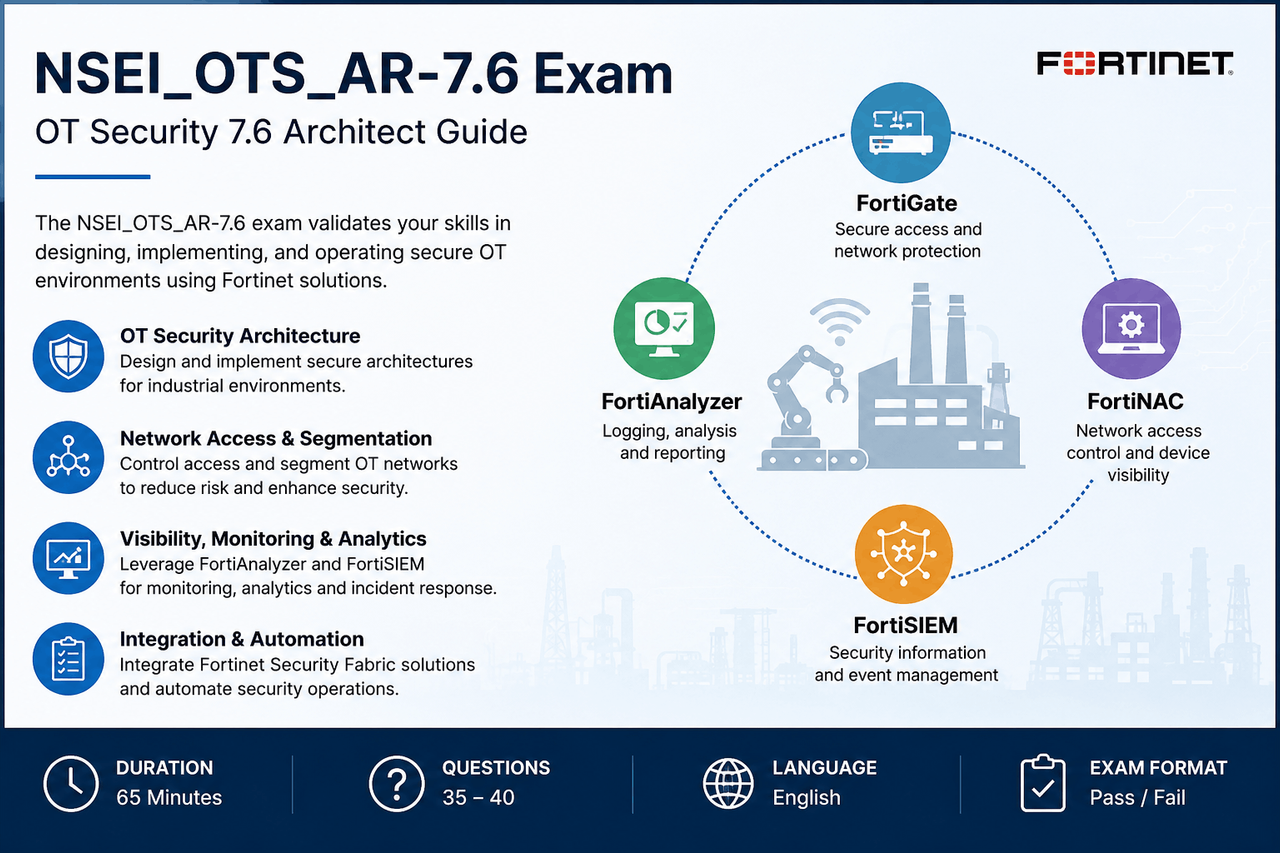
The NSEI_OTS_AR-7.6 Exam examines knowledge related to securing these environments through appropriate architecture, network controls, asset visibility, access management, industrial protocol inspection, monitoring, and risk assessment.
For anyone studying this certification, it is useful to view the examination as a collection of connected security concepts rather than a list of unrelated technical subjects.
Understanding The Purpose Of The Certification
The NSEI_OTS_AR-7.6 Exam is associated with Fortinet's OT Security 7.6 Architect certification. Its focus is on the design, implementation, operation, and integration of security solutions within operational technology environments.
The current published format lists 35-40 questions and provides 65 minutes for completion. The exam information references Fortinet technologies including FortiOS 7.6, FortiAnalyzer 7.6, FortiSIEM 7.4, and FortiNAC 7.6.
These details should always be checked against the latest official certification information because exam structures and product versions may be updated.
The architecture focus is particularly important. Candidates are expected to understand how security technologies contribute to an overall solution rather than simply knowing individual product features.
Why Visibility Is Fundamental To OT Security
One of the first questions a security team should ask is simple: What is connected to the network?
An OT environment can contain many different device types. Some may be modern and easily identifiable, while others may be older systems with specialized functions.
Without reliable visibility, security teams may have difficulty determining which devices are authorized, which systems communicate with each other, and where vulnerabilities or unexpected connections exist.
The exam objectives cover areas related to OT standards and Fortinet compliance, the Fortinet Security Fabric for OT networks, and device detection through FortiGate and FortiNAC.
Understanding these subjects helps candidates see asset visibility as the foundation for other security decisions.
From Asset Identification To Access Decisions
Asset discovery becomes more useful when it informs access control.
Suppose a device is detected on an industrial network. Simply knowing that the device exists is not enough. Security teams may need to determine what type of device it is, where it belongs, and what communication it legitimately requires.
This information can then help shape access policies.
That relationship between visibility and access is important when studying the NSEI_OTS_AR-7.6 objectives. Candidates should be able to explain how identifying an asset can contribute to making more informed network-security decisions.
The Importance Of OT Network Segmentation
Network segmentation can help organizations establish boundaries between different parts of an industrial environment.
A production network, engineering environment, management network, and other systems may have different security requirements. Allowing unrestricted communication between all of them can increase unnecessary exposure.
The exam includes OT Ethernet concepts and network segmentation schemas.
A useful way to study segmentation is to begin with business and operational requirements. Determine which systems need to communicate and why. Then consider where security boundaries should be placed.
This produces a more logical architecture than simply dividing a network into arbitrary sections.
Segmentation can also help limit the potential spread of a security incident by reducing unnecessary paths between systems.
Securing Industrial Communications
Industrial networks often use specialized communication protocols designed around operational requirements.
These protocols may carry information between controllers, monitoring systems, engineering workstations, and other industrial components.
Security inspection for industrial protocols is included in the exam objectives. Candidates should understand why visibility into industrial traffic is important and how security controls can be designed around the characteristics of OT communication.
The goal is not simply to inspect traffic for the sake of inspection. The broader purpose is to identify communication that may be inconsistent with expected behavior or security policy while respecting operational requirements.
Virtual Patching As A Compensating Control
Vulnerability management can be complicated in industrial environments.
A vulnerable device may not be easy to patch immediately. Taking a production system offline could affect operations, while a software update may require testing before deployment.
Virtual patching can provide an additional layer of protection while organizations work toward a more permanent remediation.
For exam preparation, candidates should understand where virtual patching fits within vulnerability-management strategy and why it can be useful in environments where immediate patch deployment is difficult.
It should not be interpreted as a substitute for maintaining systems properly over the long term.
Automation And Security Operations
The NSEI_OTS_AR-7.6 objectives also include automation.
Automation can help organizations handle repetitive security tasks and respond consistently to predefined conditions. In environments with large numbers of assets and security events, automation may reduce manual workload.
However, automation in OT requires careful planning. A response action that is harmless in a standard IT environment could potentially affect an operational process.
Candidates should therefore consider automation from both security and operational perspectives.
FortiSIEM And Security Event Management
FortiSIEM is another technology referenced by the exam objectives.
Security event management helps organizations collect, correlate, and analyze information from different systems.
In an OT environment, this broader visibility can help security teams connect events that may otherwise appear unrelated.
For example, unusual authentication activity combined with unexpected network communication could provide more useful context than either event viewed independently.
Candidates should therefore understand the value of correlation and centralized security visibility.
Risk Assessment In OT Environments
Risk management is particularly important in operational technology because the potential consequences of an incident can extend beyond information systems.
A security issue affecting a production controller may have different implications from one affecting a non-critical workstation.
The exam includes risk assessment and management, so candidates should understand how technical findings can be evaluated according to their potential operational impact.
A useful study method is to consider several hypothetical vulnerabilities and rank them based on factors such as asset importance, exposure, connectivity, exploitability, and potential consequences.
This helps develop risk-based thinking.
How To Use Practice Questions Correctly
Practice questions can help candidates evaluate their understanding, but their value depends on how they are used.
If a question is answered incorrectly, simply memorizing the correct answer may provide limited benefit. Instead, candidates should investigate the underlying concept and determine why the correct option is appropriate.
This is particularly important for architecture-focused questions, where several options may appear technically reasonable but only one may best satisfy the requirements of a particular scenario.
NSEI_OTS_AR-7.6 Exam Questions Resource 1
You can insert your resource naturally in the article here:
NSEI_OTS_AR-7.6 Exam Questions Resource 1: Use this resource to practice OT security concepts, review exam-related topics, and identify areas that need further study.
For an informational article, clearly identify the resource according to its actual purpose. If it is a third-party practice resource, it should not be presented as official Fortinet examination content unless that can be verified.
Creating A More Effective Study Routine
A strong study routine does not need to rely on long memorization sessions.
Begin by dividing the exam objectives into logical groups. Study asset management and visibility first because they provide the foundation for understanding the environment. Then move into segmentation and access control.
After that, focus on industrial protocol security, virtual patching, automation, monitoring, and risk management.
Finally, bring the subjects together through architecture scenarios.
This progression makes it easier to understand how one security decision influences another.
Conclusion
The NSEI_OTS_AR-7.6 Exam covers a broad range of OT cybersecurity concepts, but these subjects become easier to understand when viewed as parts of a single architecture.
Asset visibility establishes what exists. Segmentation and authentication control access. Industrial protocol inspection provides OT-aware traffic security. Virtual patching can help reduce exposure when conventional patching is difficult. Monitoring and analysis provide ongoing visibility, while risk assessment helps organizations determine what requires attention.
Candidates who build this connected understanding are better positioned to handle technical scenarios than those who rely solely on memorized information.
The most useful preparation therefore combines official objectives, current product documentation, practical exercises, and responsible use of practice questions. This approach develops knowledge that extends beyond the examination and supports a stronger understanding of cybersecurity in modern operational technology environments
- Like
- Reply
-
Share




About Us · User Accounts and Benefits · Privacy Policy · Management Center · FAQs
© 2026 MolecularCloud