NSE6_FMG_AD-7.6 Exam: Everything You Need to Know Before Preparing

NSE6_FMG_AD-7.6 Exam Guide: Syllabus, Topics, Preparation & Practice Questions
The NSE6_FMG_AD-7.6 exam is a Fortinet certification exam focused on the administration of FortiManager 7.6. It is intended for IT, network, and security professionals who need to manage FortiGate environments through centralized FortiManager administration.
Preparing for this exam requires more than memorizing product terminology. Candidates should understand how FortiManager manages devices, Administrative Domains, policies, objects, configuration changes, and troubleshooting processes. Practical experience can be particularly valuable when dealing with scenario-based questions.
This guide explains the NSE6_FMG_AD-7.6 exam structure, major topics, preparation strategy, and the appropriate use of practice questions.
What Is The NSE6_FMG_AD-7.6 Exam?
The NSE6_FMG_AD-7.6 exam is associated with the Fortinet NSE 6 - FortiManager 7.6 Administrator certification.
FortiManager provides centralized management for FortiGate devices. It allows administrators to manage multiple devices, policies, objects, and configuration changes from a central management platform.
The exam therefore focuses on the skills required to administer FortiManager and perform common management and troubleshooting tasks in a centralized Fortinet environment.
Candidates should make sure that their preparation material corresponds to the 7.6 version, because product functionality and certification objectives can change between releases.
NSE6_FMG_AD-7.6 Exam Format
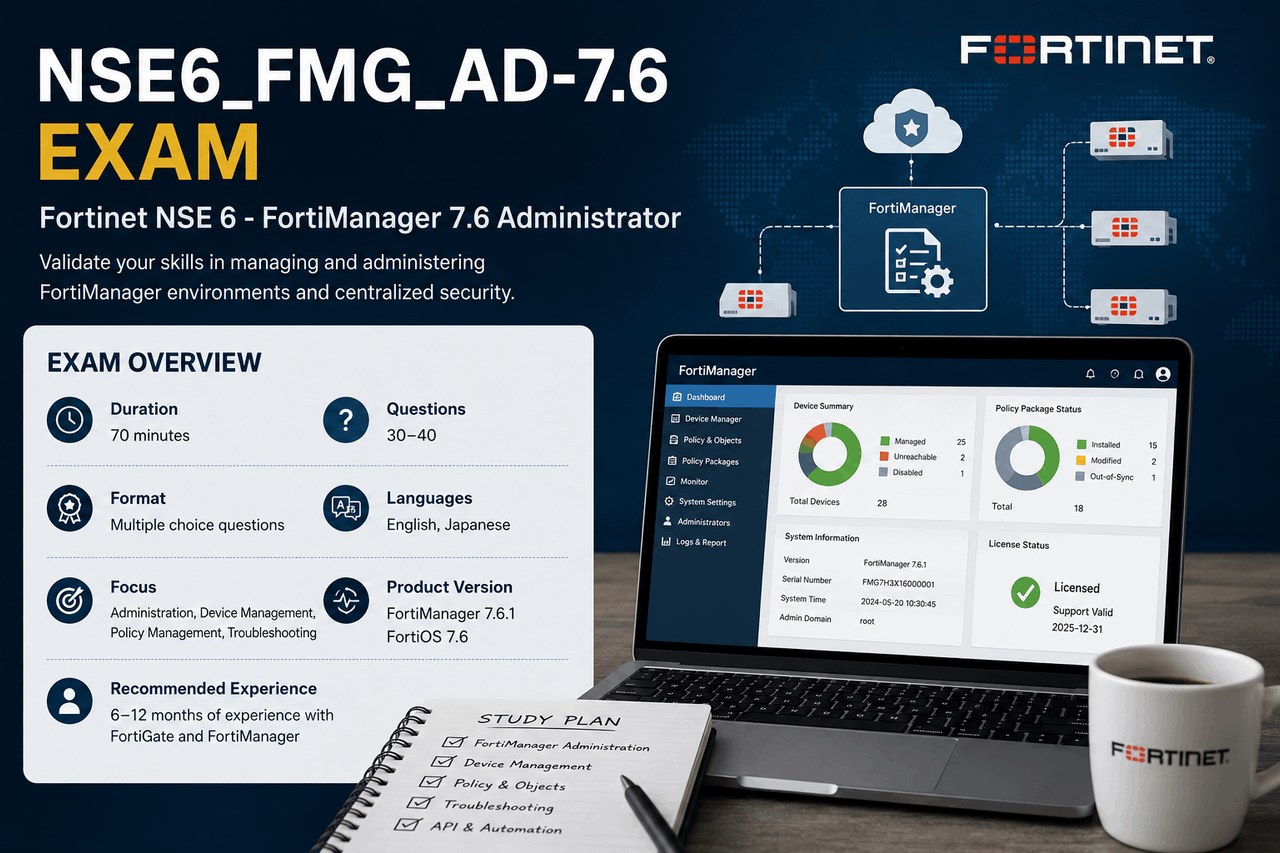
According to Fortinet's current exam information, the exam uses the following format:
- Exam code: NSE6_FMG_AD-7.6
- Exam duration: 70 minutes
- Number of questions: 30-40
- Languages: English and Japanese
- Product version: FortiManager 7.6.1 and FortiOS 7.6
The limited exam time means candidates should develop both technical knowledge and good question-reading skills.
NSE6_FMG_AD-7.6 Exam Topics
The exam covers five major domains: Administration, Device Manager, Policy and Objects, Advanced Configuration, and Troubleshooting.
Administration
The Administration domain covers the core management functions of FortiManager.
Candidates should understand Administrative Domains (ADOMs), administrator profiles, workspace mode, backup and restoration, system configuration, and FortiManager API concepts.
ADOMs are particularly important because they provide a way to organize managed devices and configurations. Candidates should understand why ADOMs are used and how administrative boundaries affect device and policy management.
API-related objectives should also be studied, including basic API concepts, supported methods, response codes, and practical use cases.
Policy And Objects
Policy and Objects is one of the most important exam domains.
Candidates should understand policy packages, firewall policies, objects, metadata variables, policy package status, configuration imports, and installation procedures.
A strong understanding of the policy workflow is important. Candidates should know how objects are created and managed, how policies use those objects, how configuration changes are reviewed, and how changes are installed on managed FortiGate devices.
The Import Configuration Wizard and installation workflow should also be included in preparation.
Rather than studying each feature separately, try to understand the complete process from configuration to deployment.
Advanced Configuration
Advanced Configuration covers more specialized FortiManager capabilities.
Topics include FortiManager High Availability, FortiGuard services, firmware caching, global database ADOMs, shared global policies and objects, and Security Fabric functionality.
Candidates should focus on understanding the purpose of each feature and the situations in which an administrator would use it.
For example, global policies and objects are particularly relevant when configurations need to be shared across multiple administrative environments.
Troubleshooting
Troubleshooting is another major area of the exam.
Candidates should prepare for problems involving device registration, FortiManager communication, configuration imports, installation failures, database integrity, system resources, and file-system issues.
Effective troubleshooting requires more than memorizing commands. Candidates should understand how to identify the source of a problem using status information, logs, revisions, diagnostic commands, and system resource information.
This is one reason hands-on FortiManager experience can be valuable during preparation.
How To Prepare For NSE6_FMG_AD-7.6
A structured preparation strategy can make the study process more efficient.
Start with the official exam objectives and identify the areas that require the most attention. Give particular focus to Policy and Objects, Device Manager, and Troubleshooting because these areas represent substantial portions of the exam objectives.
Next, combine theoretical study with hands-on practice. If you have access to FortiManager, practice creating ADOMs, registering FortiGate devices, managing policies and objects, installing configuration changes, reviewing revisions, and investigating common errors.
Fortinet's recommended learning resources include the relevant FortiManager training and hands-on labs, Administration Guide, New Features Guide, and CLI Reference.
Use Practice Questions Correctly
Practice questions can be useful for checking your understanding after studying a topic.
However, candidates should avoid treating practice questions as a substitute for learning. When you answer a question incorrectly, review the underlying FortiManager concept and verify it against authoritative documentation or a lab environment.
This approach helps build actual knowledge rather than answer memorization.
Resource 1 - NSE6_FMG_AD-7.6 Practice Questions:
https://www.dumpslink.com/NSE6_FMG_AD-7.6-pdf-dumps.html
This is the best location for your Resource 1 link because it is directly relevant to the surrounding discussion while keeping the overall article informational.
Common NSE6_FMG_AD-7.6 Preparation Mistakes
One common mistake is focusing only on definitions. The exam covers administration and troubleshooting tasks, so candidates should understand how FortiManager functions in practical environments.
Another mistake is giving too little attention to troubleshooting. Registration problems, configuration issues, installation failures, database problems, and system-resource issues can all require careful analysis.
Candidates should also avoid using outdated study material without checking whether it matches FortiManager 7.6 objectives.
Finally, do not depend entirely on question banks. Practice resources can help identify weak areas, but official documentation, training, and practical experience should remain the foundation of exam preparation.
Final Thoughts
The NSE6_FMG_AD-7.6 exam evaluates practical knowledge of FortiManager administration and centralized FortiGate management. Candidates should be comfortable with ADOMs, device management, policies and objects, advanced configuration, and troubleshooting.
The strongest preparation approach combines official Fortinet resources, hands-on practice, and carefully selected practice questions. Instead of memorizing answers, focus on understanding how FortiManager works and how an administrator would respond to realistic configuration and troubleshooting scenarios.
For informational resources published by DumpsLink, keeping the focus on accurate exam information, current objectives, practical preparation, and useful study guidance will provide readers with more genuine value than promotional messaging.
- Like
- Reply
-
Share




About Us · User Accounts and Benefits · Privacy Policy · Management Center · FAQs
© 2026 MolecularCloud