Is a Covered Padel Court Worth the Investment?

Padel has become one of the fastest-growing sports in the UK in recent years. As of March 2026, there were over 1,550 courts across 559 venues, with 860,000 players nationwide. In 2019, when the Lawn Tennis Association (LTA) first took over governance of the sport, there were just 68 courts.
The market is expanding rapidly, and new venues are opening constantly. But for club owners and investors, a more practical question follows: Is a court enough on its own? How do you ensure year-round stable operation in the UK’s rainy and windy climate? Is adding a cover to a padel court really worth it?
This article provides a practical ROI framework based on real UK weather conditions, a documented case study, and verifiable industry standards.
Why Weather Is the Biggest Challenge for Padel Clubs in the UK
How Rain Impacts Court Availability and Revenue
Padel courts are highly susceptible to weather conditions. When rain falls on tempered glass walls, the ball’s trajectory becomes unpredictable; when water accumulates on artificial turf, the surface becomes slippery and unsafe. These can lead to event cancellations, refunds, and player frustration and dissatisfaction.
Seasonal Downtime and Revenue Instability of Outdoor Courts
The biggest problem facing outdoor padel courts is not the occasional cancellations, but the low utilization rate during the months-long winter. Players learn that “booking in winter depends on the weather,” so they simply stop trying. For the club, this not only means a loss of booking fees, but may also lead to the loss of potential member conversion opportunities. The revenue curve of an uncovered court fluctuates dramatically: revenue surges in good weather and drops to almost zero in bad weather, making cash flow difficult to predict.
What Is a Covered Padel Court
Covered Padel Courts vs Fully Indoor Facilities
Covered courts are often misunderstood as “indoor padel courts for people on a budget.” In reality, they offer a completely different experience: open on all sides, good airflow, natural light, and rain protection. Players describe it as a “semi-indoor” experience—more reliable than outdoor, more comfortable than indoor.
Core Components of an Integrated Cover System
A complete padel court cover system typically consists of three core components:
| Component | Function |
| Structural Frame | Load-bearing support and overall stability |
| Roofing System | Waterproof enclosure to block rain |
| Sealing & Fixing | Prevents leaks at joints and screw points |
Unlike fabric membrane structures that require annual re-tensioning, steel-and-polycarbonate systems typically have a design lifespan exceeding 12 years with routine inspection only.
Our Integrated Padel Court Cover System
Having covered the general concept and core components of a covered padel court, let us now explain how our system puts these principles into practice.
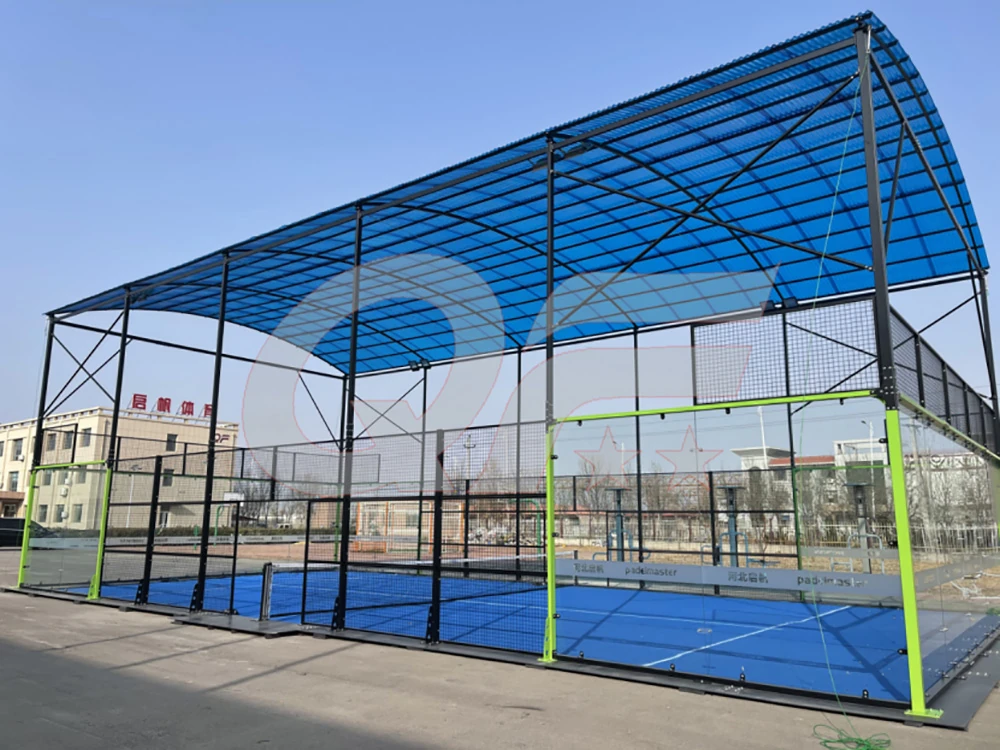
SPHC Steel Structure and PC Roof
Our integrated padel court cover system uses high-quality SPHC hot-rolled steel. It is stronger and more corrosion-resistant than standard steel tubing. For UK coastal areas, where salt spray speeds up corrosion, this difference determines the structure’s lifespan.
The roofing system uses high-performance polycarbonate (PC) panels. This material is completely waterproof while allowing natural light to pass through. With open sides, air circulates freely, and sunlight is diffused rather than harsh.
Mechanical Waterproof Sealing System
We use high-strength galvanized screws and rubber waterproof pads for mechanical sealing at all joints and screw points. This sealing method requires no repeated applications of sealant over time. Once installed, the risk of rainwater leakage is completely eliminated.
Wind Resistance and Certifications
Our system fully complies with BS EN Eurocode 1 structural standards, withstanding coastal winds up to 34m/s (Beaufort scale 9–10). We also provide the following certification documents:
- GB 19272-2011 – General safety requirements for outdoor fitness equipment
- GB/T 20394-2013 – Artificial turf for sports (superior grade)
- EN 12150-2:2004 – Toughened glass, CE certified under EU CPR 305/2011
Installed in 2–3 Days: Modular & Prefabricated
Our system uses modular prefabricated construction. All steel components are laser-cut, bent, and pre-drilled in the factory. No on-site cutting or welding is required. With a team of six to seven workers, installation is completed in 2–3 days after the concrete base is ready.
Colour Customisation
Our system supports canopy colour customisation. PC panels are available in multiple colours, and the steel frame can be powder-coated in any RAL colour. Clubs can match the canopy colour to their brand identity, making the court part of the club’s overall visual design.
- Like
- Reply
-
Share




About Us · User Accounts and Benefits · Privacy Policy · Management Center · FAQs
© 2026 MolecularCloud