How Do Stainless Steel Support Rods Improve Wedge Wire Screen Performance?

Introduction
Industrial filtration refers to the process of improving the quality and purity of industrial fluids through separation and purification technologies. This process places strict performance requirements on filtration screens.
Wedge wire screens are characterized by excellent wear resistance, corrosion resistance, high flow capacity, and easy cleaning, making them widely used in industries such as petrochemicals and wastewater treatment.
In demanding filtration applications, these screens rely heavily on their internal support structures. The ability to maintain consistent filtration precision over the long term depends largely on the underlying support framework—with stainless steel support rods serving as the core component of that structure.
Acting as the “backbone” of the screen, these support rods maintain precise slot openings even under high mechanical stress and prevent the shaped wires from deforming during backwashing, thereby significantly extending the screen’s service life. Understanding support rod design helps engineers select more reliable filtration solutions with longer service life and lower maintenance requirements.
What Are Stainless Steel Support Rods?
Stainless steel support rods are structural components used to support and connect the profile wires in a welded wire screen structure. They are normally positioned perpendicular to the profile wires and welded together to create a strong filtration element.
In a typical Profile Wire Screen, the structure consists of two main parts:
| Component | Function |
| Profile Wire / V Wire | Creates the filtering surface and controls slot openings |
| Stainless Steel Support Rods | Provides mechanical support and maintains structural stability |
The profile wire determines filtration accuracy, while the support rods provide the foundation that keeps the entire structure stable during operation.
Stainless steel support rods can be used as supporting components for wedge wire screen cylinders, helping maintain structural stability and improve the overall strength of filtration systems.
Without sufficient support, the screen may experience deformation, uneven openings, or reduced filtration efficiency. Therefore, selecting suitable support rods is essential when designing a reliable wedge wire screen element.
Support Rod Arrangement Options for Wedge Wire Screens
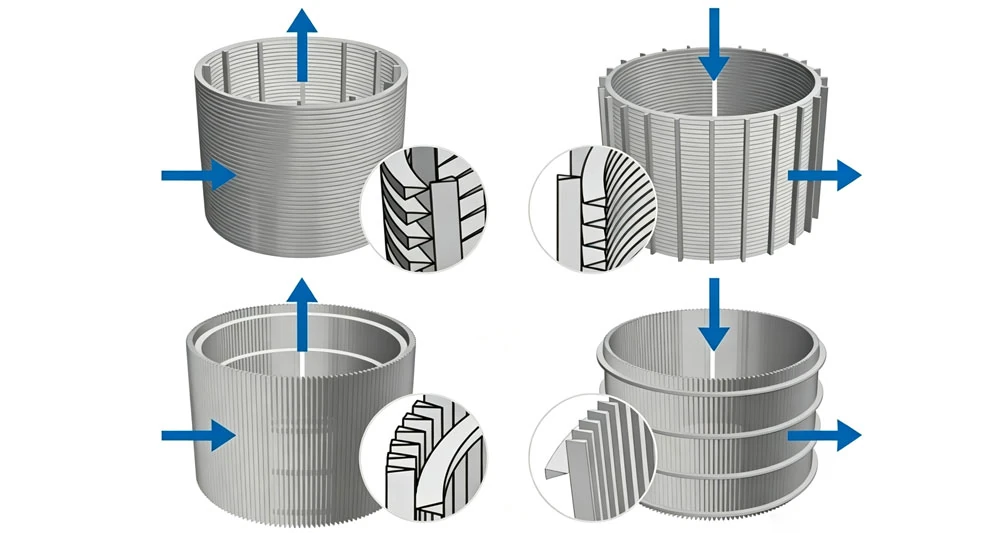
The arrangement of support rods is an important factor affecting the mechanical strength, filtration direction, and application performance of wedge wire screens. By changing the position and orientation of the winding wire and support rods, different structural configurations can be designed to meet various filtration requirements.
Horizontal Winding Wire with Longitudinal Support Rods (Wire Outside, Rod Inside)
This is the most common and widely used support rod arrangement for wedge wire screens. In this structure, the winding wire is positioned outside while the support rods are installed inside. The fluid flows from the outside-to-inside (FOTI)
Due to its balanced strength and filtration performance, this configuration is suitable for a wide range of applications, including water well screens, geothermal wells, municipal water treatment, wastewater treatment, and medium- and low-pressure oil and gas sand control systems.
Horizontal Winding Wire with Longitudinal Support Rods (Wire Inside, Rod Outside)
In this reverse arrangement, the winding wire is located inside, the support rods are placed outside. The fluid flows from the inside of the screen to the outside (FITO).
This structure is specially designed for applications requiring reverse filtration flow, such as internal-flow self-cleaning filters, process pipelines with internal feeding, and working environments where the external surface of the screen may experience wear, collision, or mechanical impact.
Longitudinal Winding Wire with Horizontal Support Rods (Wire Outside, Rod Inside)
This configuration uses longitudinal winding wires combined with horizontal support rods, with the winding wire positioned outside and the support rods inside.
Compared with conventional structures, this arrangement provides higher compressive strength and improved structural stability. It is mainly used for deep wells, ultra-deep well water intake systems, high-pressure oil and gas well completion, and other extreme conditions requiring excellent pressure resistance.
Longitudinal Winding Wire with Horizontal Support Rods (Wire Inside, Rod Outside)
In this structure, the winding wire is installed inside while the support rods are arranged outside. It is designed for high-pressure internal-flow filtration systems and applications involving fluids with high levels of sand and impurities.
This support rod configuration provides both high mechanical strength and reliable internal filtration performance, making it suitable for demanding industrial filtration processes where pressure resistance and reverse flow cleaning are required.
The Importance of Stainless Steel Support Rods
Improving Structural Strength and Stability
The primary function of stainless steel support rods is to improve the mechanical strength of filtration structures.
During operation, industrial screens may face:
- Continuous material flow
- Pressure differences during filtration
- Mechanical vibration
- Impact caused by solid particles
Support rods distribute these forces throughout the screen structure and reduce the risk of deformation. A properly designed support system helps maintain the original slot size and ensures consistent filtration performance.
For heavy-duty applications, engineers usually consider factors such as support rod shape, spacing, and material grade to match the operating environment.
Common support rod designs include:
| Support Rod Type | Characteristics |
| Round Rod | Suitable for general structural support |
| Rectangular Rod | Provides stronger rigidity |
| Trapezoidal Rod | Offers stable welding contact |
| Customized Shapes | Designed according to specific requirements |
Maintaining Accurate Filtration Performance
A major advantage of a wedge wire screen is its precise filtration opening. The distance between profile wires determines the size of particles that can pass through the screen.
However, maintaining consistent slot openings requires a stable supporting structure.
Stainless Steel Support Rods help:
- Keep profile wires in fixed positions;
- Maintain uniform slot spacing;
- Reduce deformation during operation;
- Support long-term filtration accuracy.
For applications requiring precise separation, such as water filtration and industrial screening, the structural design of the support system is an important consideration.
Enhancing Corrosion Resistance in Harsh Environments
Many filtration systems operate in environments involving water, chemicals, minerals, or other corrosive media. Stainless steel is widely selected because of its corrosion resistance and durability.
Common material options include:
| Material | Typical Application |
| Stainless Steel 304 | General industrial filtration applications |
| Stainless Steel 316L | Environments requiring higher corrosion resistance |
For example, 316L stainless steel is commonly selected for applications involving seawater, chemical processing, or other demanding conditions.
By selecting the appropriate stainless steel grade, customers can improve the service life and reliability of their custom wedge wire screen solutions.
Key Factors for Choosing Stainless Steel Support Rods
Selecting suitable support rods requires consideration of several engineering factors.
Material Selection
The working environment determines the appropriate stainless steel grade.
- 304 stainless steel is suitable for many general applications.
- 316L stainless steel is preferred when higher corrosion resistance is required.
Shape and Size Requirements
The support rod design should match the structure of the filtration system.
Important factors include:
- Rod shape;
- Diameter or cross-section;
- Welding structure;
- Support spacing.
Different designs can influence the strength, open area, and filtration performance of the final wedge wire screen.
Custom Manufacturing Capabilities
Many filtration projects require non-standard solutions. A professional stainless steel wire manufacturer should be able to provide customized options based on customer drawings or application requirements.
Customization may include:
- Different support rod shapes;
- Customized dimensions;
- Specific material selections;
- Special welding configurations.
This flexibility enables customers to develop wedge wire screens that match their equipment requirements and operating conditions.
Why Choose JINGZHOU Metal for Stainless Steel Support Rod Solutions?
Selecting a reliable stainless steel support rod supplier is essential for ensuring the strength, durability, and filtration performance of wedge wire screens. With professional manufacturing experience and customized production capabilities, JINGZHOU Metal provides high-quality support rod solutions for various industrial filtration applications.
Professional Product Specifications
| Technical Parameter | Specification Details |
| Material Grade | Stainless Steel 304, 316, 316L, 321, 430 |
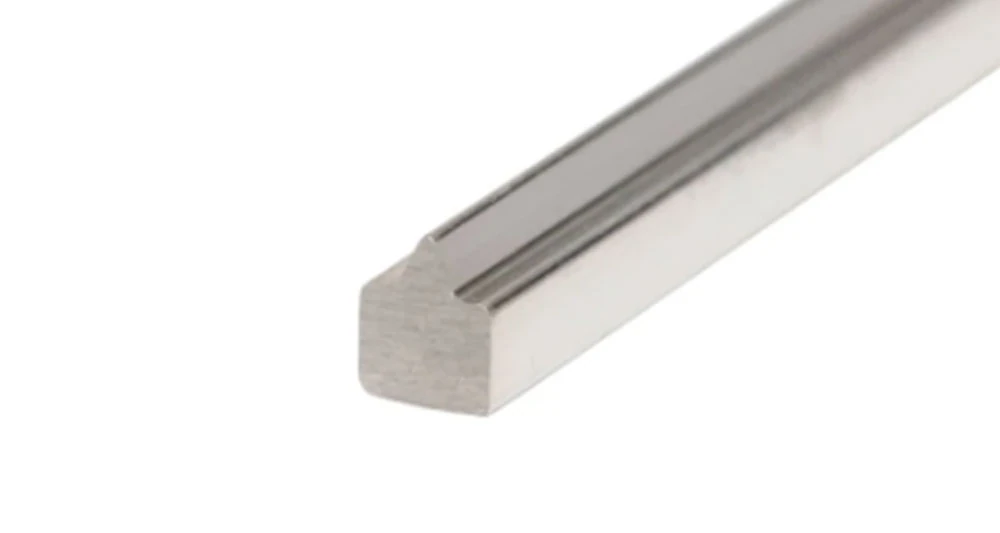
| Rod Shapes | Round, Triangular (V-shape), Flat, or Tear-drop |
| Common Dimensions (mm) | 3.8×4.5mm,2×2.98mm |
| Support Distance | Minimum 0.5mm |
| Dimensional Tolerance | +/- 0.01mm |
| Production Capacity | 1,200 tons / month |
| Surface Finish | Bright / Matte |
| Delivery Form | Straight bars (bundled) or Coils |
Stainless steel support rods can be used as supporting components for wedge wire screen cylinders.Finished screen cylinders are packed in wooden cases to ensure safe delivery and protect products from damage during transportation.
Customized Support Rod Designs for Different Applications
Different wedge wire screen structures require different support rod designs. JINGZHOU Metal offers customized support rods in various shapes.
By adjusting the shape, size, and arrangement of support rods, customers can achieve better welding contact, improved structural stability, and optimized filtration performance for specific operating conditions.
Suitable for Highly Corrosive Environments
Jingzhou offers materials covering more than ten stainless steel grades (including 304, 316L, 2205, 2507, etc.), capable of meeting the material requirements for support rods across various demanding operating conditions.
Integrated Manufacturing Capability
JINGZHOU Metal has integrated manufacturing capabilities, enabling better control over raw material quality, production efficiency, and product consistency. This helps ensure stable supply capability, flexible customization, and cost-effective stainless steel support rod solutions.
FAQ
Q1. What are the common dimensions for wedge wire screen support rods?
Common cross-sectional shapes for support rods include round rods (diameter 2.5–6.0 mm) and rectangular/trapezoidal profiles (width 2.3–3.7 mm, height 2.7–6.3 mm). Jingzhou Metal can provide larger support rods—such as T-shaped and house-shaped profiles (e.g., 3.0×5.0 mm, 3.0×6.0 mm, 5.0×8.0 mm, 5.0×10.0 mm)—in various stainless steel grades like 304, 316L, and 2205, and also supports customization based on customer drawings.
Q2. What is the function of stainless steel support rods in wedge wire screens?
Stainless steel support rods reinforce wedge wire screens, keeping the slots precise, stable, and durable over time.
Q3. Can support rods be customized for different filtration systems?
Yes. Support rods can be customized in terms of shape, size, material, and structure to meet different custom wedge wire screen requirements.
Conclusion
Support rods are the fundamental structural components within wedge wire screens. While the profile wires determine filtration precision, the support rods dictate the screen’s overall strength and durability.
In industrial sectors such as wastewater treatment, mining, and oil & gas, selecting the right support rods ensures high-quality wedge wire screens. This enhances durability, maintains consistent filtration flow, extends service life in harsh operating environments, and reduces unnecessary maintenance and waste,thereby ensuring smooth project operations.
By combining premium materials, custom engineering, and precision manufacturing, JINGZHOU Metal delivers high-performance wedge wire screen solutions tailored to your specific operational requirements.
- Like
- Reply
-
Share




About Us · User Accounts and Benefits · Privacy Policy · Management Center · FAQs
© 2026 MolecularCloud