Cardiopulmonary Exercise Testing (CPET) vs Stress Test: What’s the Difference?

1. What Is a Stress Test?
A stress test, also known as a treadmill test or exercise ECG, assesses how the heart performs under physical stress. As exercise intensity increases — typically by walking or running on a treadmill, or pedaling a stationary bicycle — the heart is required to pump more blood. In response, heart rate rises, the heart rhythm may adapt, and electrical activity (recorded by ECG) changes accordingly. These responses help clinicians evaluate cardiac function under controlled conditions.
1.1 How Does a Traditional Stress Test Work?
During a standard exercise stress test, electrodes attached to the patient’s chest continuously record a 12-lead ECG, while blood pressure is measured at regular intervals. The test continues until one of two endpoints is reached: either the patient achieves a target heart rate (predetermined by age), or they develop symptoms that suggest stopping — such as chest pain, severe shortness of breath, or concerning changes on the ECG.
1.2 What Parameters Does a Stress Test Measure?
Traditional stress testing focuses primarily on:
Heart rate response to exercise
Blood pressure changes
ECG abnormalities, especially ST-segment depression or elevation
Patient-reported symptoms (fatigue, angina, dyspnea)
1.3 Common Clinical Applications of Stress Testing
Stress ecg machines are widely used to diagnose coronary artery disease, assess the severity of known cardiac conditions, guide exercise prescriptions, and evaluate the effectiveness of medical or interventional treatments.
2. What Is Cardiopulmonary Exercise Testing (CPET) and What Data Does It Provide?
Cardiopulmonary exercise testing (CPET) far surpasses traditional stress testing. While traditional stress tests primarily focus on the heart’s electrical activity, CPET enables a comprehensive, non-invasive assessment of the integrated functioning of the cardiovascular, respiratory, and metabolic systems during exercise.
CPET machine analyzes a patient’s breathing, precisely revealing the efficiency with which the body takes in oxygen and expels carbon dioxide. That’s why CPET is the preferred test when doctors need to find the cause of unexplained breathlessness or exercise limitation.
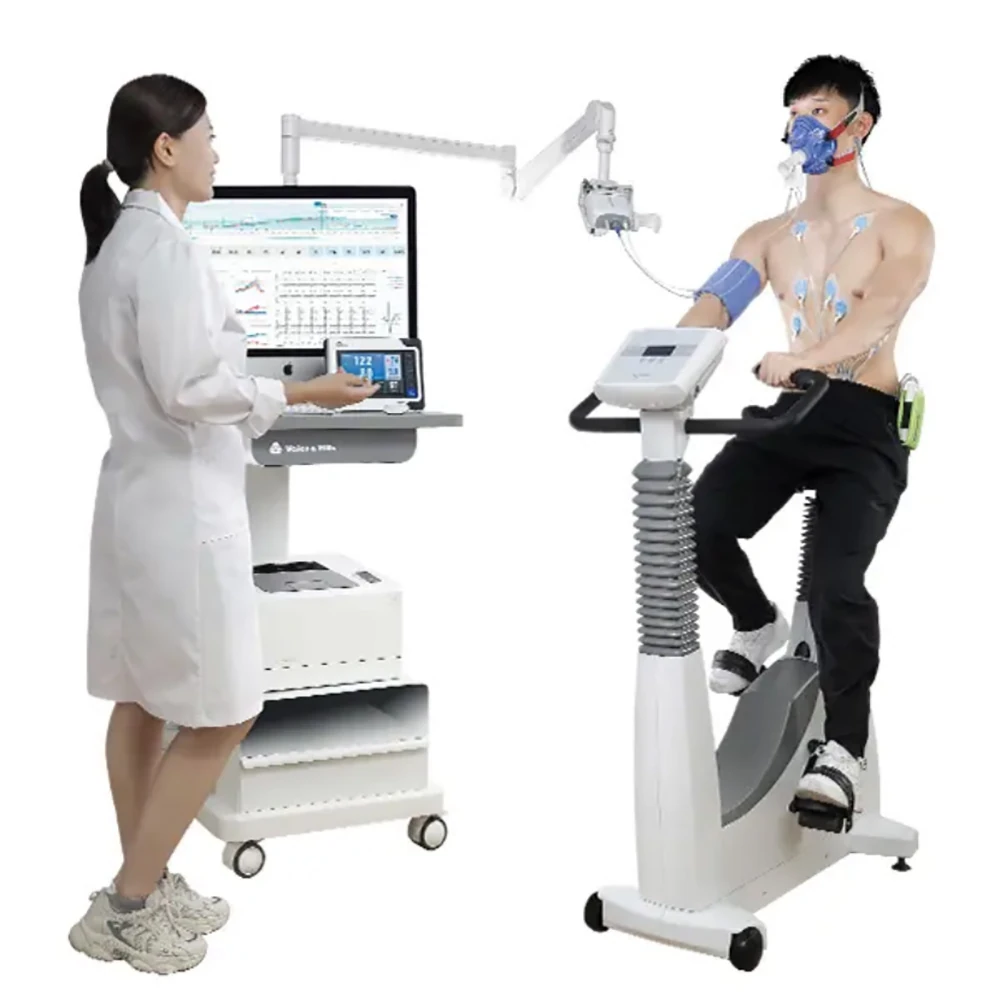
2.1 How CPET Evaluates Heart, Lung, and Metabolic Function
Unlike traditional exercise stress tests, cardiopulmonary exercise testing (CPET) can pinpoint the specific factors limiting a patient’s exercise capacity—whether they involve the heart, lungs, blood vessels, or muscles. For instance, someone with heart failure will have low peak oxygen use and a lower anaerobic threshold. Someone with lung disease, on the other hand, will show poor ventilatory efficiency.
2.2 Key Components of a CPET System
A complete CPET system typically includes:
- A metabolic cart with gas analyzers (O₂ and CO₂ sensors)
- A flow sensor (pneumotachograph)
- A facemask or mouthpiece with a one-way valve
- A 12-lead ECG monitor
- A pulse oximeter for SpO₂ monitoring
- A blood pressure monitor (stress BP)
- An ergometer (treadmill or bicycle)
For example, our V&H CPET system integrates ECG, O₂/CO₂ analysis, SpO₂ monitoring, and stress blood pressure measurement into a single platform. Running on Apple macOS, its All-in-One timeline design and Bluetooth connectivity simplify the setup process, while the high-color-accuracy display clearly visualizes subtle ST-segment changes — delivering an efficient diagnostic experience.
2.3 VO₂, VCO₂, and Ventilatory Efficiency
- Oxygen consumption (VO₂): VO₂ increases linearly with work rate until a plateau at maximal exercise. A low peak VO₂ indicates poor functional capacity regardless of the underlying cause.
- Carbon dioxide production (VCO₂): VCO₂ reflects metabolic CO₂ production from aerobic and anaerobic metabolism. The VCO₂/VO₂ ratio (respiratory exchange ratio, RER) confirms true maximal effort when ≥1.10.
Ventilatory efficiency (VE/VCO₂ slope): This parameter is a strong predictor of outcomes in patients with heart failure and pulmonary hypertension. An elevated slope means the patient’s breathing is inefficient. In simple terms, they have to breathe more — either more often or more deeply — to get rid of the same amount of carbon dioxide as a healthy person. This often results from increased dead space (areas of the lung that do not participate in gas exchange) or abnormal chemosensitivity (an exaggerated breathing response to carbon dioxide).
Together, these measurements help pinpoint the root cause of exercise intolerance — whether it is normal, cardiac (heart), pulmonary (lung), or due to deconditioning or peripheral factors (muscles or circulation).
3. Comparison Table: CPET vs Stress Test
| Feature | Traditional Stress Test | CPET |
| ECG monitoring | Yes | Yes |
| Heart rate / BP | Yes | Yes |
| Oxygen consumption (VO₂) | No | Yes |
| Carbon dioxide output (VCO₂) | No | Yes |
| Ventilation (VE) | No | Yes |
| Gas exchange efficiency | No | Yes (VE/VCO₂, PetCO₂) |
| Differentiates cardiac vs pulmonary | No | Yes |
| Identifies anaerobic threshold | No | Yes |
| Prognostic value in heart failure | Limited | Strong (VE/VCO₂ slope, peak VO₂) |
Key takeaway: A stress test can suggest ischemia but cannot quantify how much the heart, lungs, or muscles contribute to exercise limitation. CPET directly measures gas exchange, revealing the physiological mechanism rather than just electrical abnormalities.
4. When Should Healthcare Providers Choose a Stress Test?
Ideal Use Cases and Limitations
Traditional stress testing remains appropriate for low-to-intermediate risk patients with suspected coronary artery disease when the baseline ECG is normal and the primary question is whether ischemia exists.
Advantages:
Low cost, wide availability, straightforward interpretation.
Limitations:
Lower sensitivity/specificity, inability to assess pulmonary or metabolic function, high rate of inconclusive results (especially in women and patients with baseline ECG abnormalities).
5. When Should Healthcare Providers Choose CPET?
CPET is the preferred test in the following scenarios:
- Evaluation of unexplained dyspnea – When dyspnea outlasts what is expected from a known cardiac or pulmonary diagnosis, or when the cause remains unclear after standard testing.
- Preoperative risk assessment – For major thoracic or abdominal surgery, CPET parameters (anaerobic threshold, peak VO₂) predict postoperative complications and mortality more accurately than any other single test.
- Cardiac rehabilitation programs – Provides objective data for exercise prescription, risk stratification, and outcome tracking in patients after myocardial infarction, heart failure, or cardiac surgery.
- Pulmonary rehabilitation programs – In COPD, interstitial lung disease, and pulmonary hypertension, CPET guides oxygen therapy settings, monitors disease progression, and evaluates treatment efficacy.
- Sports medicine and performance evaluation – Athletes undergo CPET to determine maximal aerobic capacity, training zones, and to identify subtle limitations that standard stress tests would miss.
6. Modern CPET Technology: All-in-One and Portable Solutions
Traditional CPET systems were large, stationary, and often required separate devices for ECG, gas analysis, and blood pressure monitoring. Modern all-in-one designs minimize cable clutter, reduce equipment footprint, and simplify training requirements. Clinicians can view all waveforms—ECG, flow-volume loops, gas exchange curves, and SpO₂ trends—on a single screen without toggling between applications.
Our V&H CPET system exemplifies this shift. It is a CPET system running on Apple macOS, featuring an innovative software display with a singular frame that dynamically integrates past, present, and future data at a glance. Being portable, it opens up a multitude of usage scenarios—clinical, rehabilitation, laboratory, ward, sports, and home settings, both indoors and outdoors.
This portability is not just about size; it brings the same measurement accuracy to bedside, community clinics, sports fields, and even home-based rehabilitation, greatly expanding access to high-quality cardiopulmonary assessment.
7. Frequently Asked Questions
Q1: Is CPET more accurate than a traditional stress test?
Yes, for most indications beyond simple ischemia detection. CPET test provides additional physiological data that directly identifies the cause of exercise limitation, whereas a stress test only suggests possible ischemia.
Q2: Can CPET detect both cardiac and pulmonary disorders?
Yes. CPET is uniquely capable of differentiating cardiac from pulmonary causes of dyspnea and exercise intolerance, and it can often identify mixed etiologies.
Q3: Who should undergo a CPET examination?
Patients with unexplained dyspnea, heart failure, COPD, interstitial lung disease, pulmonary hypertension, preoperative risk evaluation, unexplained exercise intolerance, or athletes requiring precise functional assessment.
Q4: How long does a CPET test take?
Setup and calibration take approximately 15–20 minutes. The exercise portion typically lasts 8–15 minutes, followed by a 5–10 minute recovery period. Total appointment time is usually 45–60 minutes.
Q5: Is CPET suitable for rehabilitation and sports medicine?
Absolutely. CPET is the standard for exercise prescription in cardiac and pulmonary rehabilitation and is widely used in sports medicine for performance optimization.
8. Conclusion
Traditional stress testing remains a valuable, low-cost tool for diagnosing coronary artery disease in selected low-to-intermediate risk patients with normal baseline ECGs. However, for the many patients whose symptoms suggest a broader differential diagnosis—including unexplained dyspnea, mixed cardiac-pulmonary disease, or exercise intolerance of unclear origin—CPET offers far superior diagnostic and prognostic information.
By measuring gas exchange directly, CPET uncovers the physiological mechanism of exercise limitation rather than simply detecting electrical abnormalities. With modern integrated and portable CPET systems, this advanced assessment is becoming more accessible across clinical, rehabilitation, sports, and community settings. For healthcare providers seeking to improve diagnostic accuracy, optimize treatment decisions, and truly understand their patients’ functional capacity, CPET is the preferred choice.
- Like
- Reply
-
Share




About Us · User Accounts and Benefits · Privacy Policy · Management Center · FAQs
© 2026 MolecularCloud