AB-410 Study Guide: Practical Preparation Roadmap and Exam Topics

AB-410 Study Guide: A Practical Roadmap For Building Intelligent Applications
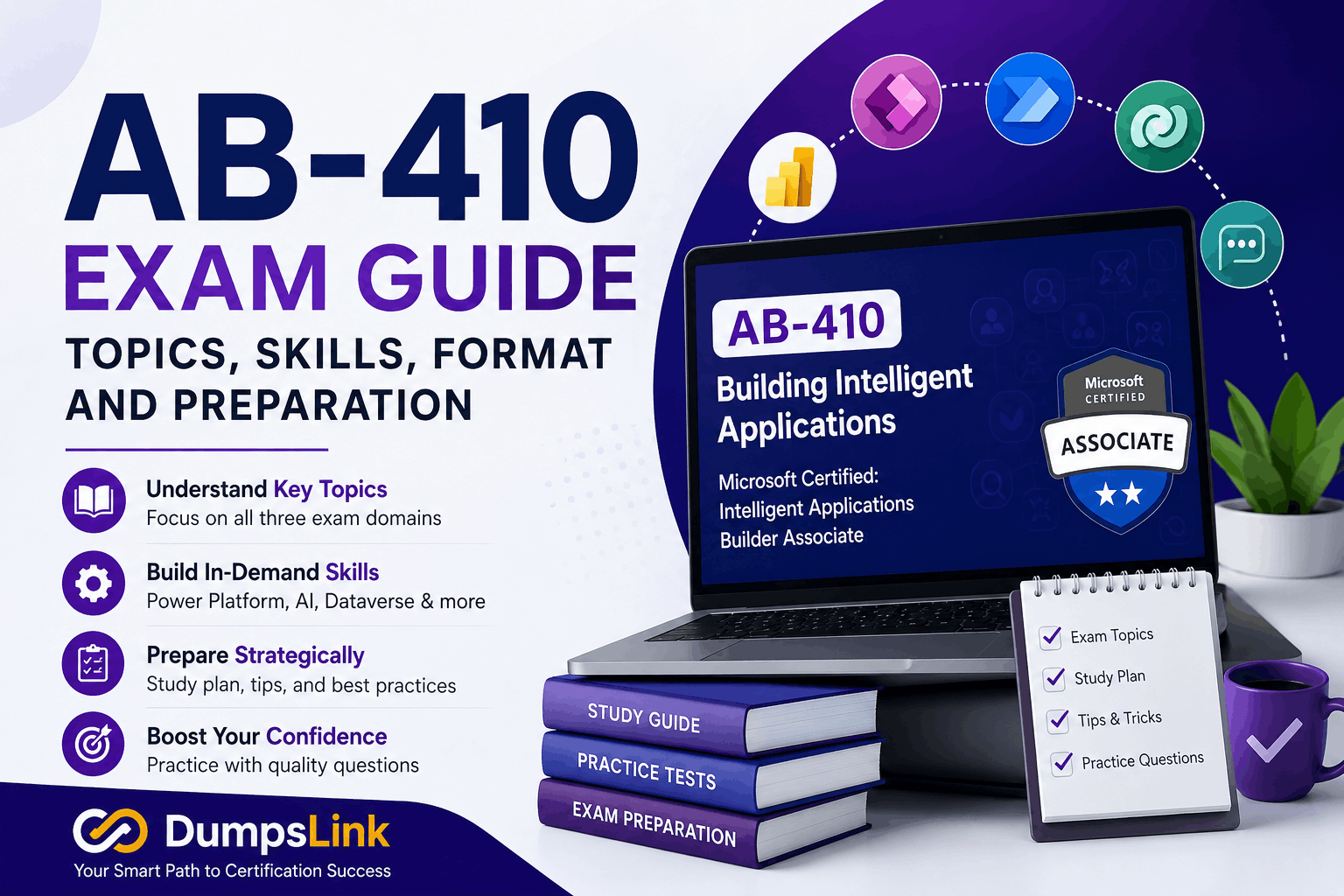
Preparing for the AB-410 exam requires more than learning a list of Microsoft Power Platform features. The exam, titled Building Intelligent Applications, focuses on how professionals use AI, low-code development, data, automation, and application logic to create practical business solutions.
Microsoft's current study guide describes the target candidate as someone who builds AI-powered solutions with Microsoft Power Platform using Copilot, natural-language prompts, low-code tools, applications, data models, flows, agents, and AI models. It also recommends gaining hands-on experience before taking the exam.
For that reason, an effective AB-410 preparation strategy should combine official documentation with practical exercises and focused review.
Understanding What AB-410 Is Testing
AB-410 is organized around three major skill areas:
✅ Create a foundation for intelligent applications - 25-30%
✅ Create intelligent applications - 25-30%
✅ Build business application logic and automation - 40-45%
The third area carries the largest percentage, so candidates should give substantial attention to automation, prompts, AI models, and business logic. However, the other two areas should not be ignored because they establish the data and application foundation required for intelligent solutions.
The exam is therefore best approached as a connected set of skills rather than three completely separate subjects.
Start Your AB-410 Preparation With The Official Objectives
Before choosing study materials, review the official AB-410 objectives and turn them into a personal checklist.
This gives you a way to separate topics you already understand from those that require additional practice.
For example, a candidate with strong Power Apps experience may already be comfortable with canvas apps but have less experience with AI models, Copilot Studio agents, or application lifecycle management.
Another candidate may understand Dataverse well but need more practice with Power Automate troubleshooting.
This type of self-assessment helps prevent inefficient studying.
Create Three Study Categories
Organize your notes into three broad sections:
✅ Foundation
Focus on requirements analysis, Power Platform solution design, environments, ALM, Dataverse, tables, columns, relationships, views, forms, and security.
✅ Applications
Study model-driven apps, canvas apps, accessibility, performance, responsiveness, reusable components, variables, collections, error handling, testing, and Monitor.
✅ Automation and AI
Concentrate on cloud flows, triggers, connectors, approvals, conditions, loops, troubleshooting, prompts, AI models, business rules, business process flows, and calculated, rollup, and formula columns.
This structure mirrors Microsoft's current skills outline and makes revision easier.
Build A Strong Dataverse Foundation
Dataverse is one of the most important areas to understand because it provides the data foundation for many Power Platform solutions.
During preparation, don't simply memorize the names of Dataverse components. Practice understanding how they work together.
Spend time with:
✅ Tables and standard tables
✅ Columns and their properties
✅ Table relationships
✅ Forms
✅ Views
✅ Security
✅ Public views
✅ Prompt columns
✅ Row summaries
✅ Calculated and rollup columns
✅ Formula columns
Try creating a small data model yourself. For example, you might create tables representing customers, service requests, and support employees. Then consider how those tables relate and which information belongs in each column.
Practical exercises make it easier to understand why one design may be preferable to another when presented with a business scenario.
Practice Both Types Of Power Apps
AB-410 includes both model-driven apps and canvas apps, so preparation should cover both.
For model-driven applications, review forms, views, app composition, access configuration, charts, dashboards, and generative pages.
For canvas applications, practice connecting data, designing responsive and accessible interfaces, using reusable components, managing variables and collections, handling errors, and testing applications.
Microsoft's objectives also include named formulas, user-defined functions, component libraries, Monitor, and creating a Copilot Studio agent from a canvas app.
The best way to study these topics is to build small applications instead of only reading about them.
A simple application can give you experience with data connections, controls, formulas, error handling, testing, and usability in one exercise.
Give Extra Attention To Power Automate
Because business application logic and automation accounts for 40-45% of the exam, Power Automate deserves significant preparation time.
Work on cloud flows and learn how to choose appropriate:
✅ Triggers
✅ Connectors
✅ Actions
✅ Conditions
✅ Loops
✅ Approval processes
Also practice testing and troubleshooting.
When a flow does not behave as expected, don't immediately rebuild it. Examine the trigger, inputs, actions, conditions, and outputs to identify where the problem occurs.
This type of troubleshooting practice is more valuable than simply following a tutorial from beginning to end.
Study Prompts And AI Models As Practical Tools
AI is a central part of the AB-410 subject area.
Microsoft's objectives include building prompts from templates or from scratch, adding inputs and knowledge, customizing prompt settings and models, and using prompts and AI models in applications and cloud flows.
When studying these topics, focus on practical use cases.
Ask questions such as:
✅ What information should the prompt receive?
✅ What knowledge should be available to it?
✅ Where should the prompt be used?
✅ Would the prompt be more useful inside an application or a flow?
✅ What should happen when the AI output is incomplete or unexpected?
Thinking in terms of business requirements helps connect AI capabilities to real application design.
Don'T Ignore Copilot Studio And Agents
AB-410 candidates should also have awareness of creating agents with Microsoft Copilot Studio.
The goal is not simply to recognize the name of the product. You should understand how agents can fit into a larger business solution.
Consider an example where employees need assistance finding information or completing a repetitive task. You could evaluate whether an agent, application feature, automation flow, or combination of these tools would provide the most appropriate solution.
This requirement-focused approach is useful because the exam expects candidates to map business processes to flows, agents, or application capabilities.
Use Practice Questions As A Diagnostic Tool
Practice questions can be useful during AB-410 preparation, but they work best when used to identify knowledge gaps.
Add Your AB-410 Exam-Question Resource Here: https://www.dumpslink.com/AB-410-pdf-dumps.html
After completing a practice question, don't focus only on whether your answer was correct.
Instead, ask why the answer is correct.
If you choose the wrong option, identify the underlying topic. Then review the relevant documentation or test the feature in a practice environment.
This creates a useful cycle:
Question → Identify gap → Study concept → Practice feature → Reattempt
That approach is much more valuable than memorizing answer patterns.
A Simple AB-410 Study Roadmap
A structured roadmap can make preparation easier.
Step 1: Review The Skills
Read the official AB-410 study guide and list every skill measured.
Step 2: Rate Your Knowledge
Give yourself a simple rating for each topic:
✅ Strong
✅ Familiar
✅ Needs practice
This quickly identifies your priorities.
Step 3: Strengthen The Foundation
Review Dataverse, solution design, environments, security, and ALM concepts.
Step 4: Build Applications
Create both canvas and model-driven applications. Practice using data, forms, views, components, formulas, and testing tools.
Step 5: Build Automation
Create cloud flows involving triggers, connectors, conditions, loops, actions, and approvals.
Step 6: Explore AI Capabilities
Practice prompts, AI models, Copilot capabilities, and agent-related scenarios.
Step 7: Test Your Knowledge
Use practice questions to identify weak areas rather than treating them as your only study source.
Step 8: Revisit Weak Topics
Return to Microsoft Learn documentation and hands-on exercises for the subjects you consistently miss.
How To Know When You'Re Ready
Being able to recognize a Power Platform feature is not necessarily the same as being ready for AB-410.
A better readiness test is whether you can explain why a particular feature should be used in a business scenario.
Before the exam, check whether you can confidently:
✔ Design a basic Dataverse data model
✔ Explain table relationships
✔ Configure forms and views
✔ Understand security concepts
✔ Build model-driven applications
✔ Build canvas applications
✔ Use reusable components and Power Fx
✔ Test and troubleshoot apps
✔ Build Power Automate cloud flows
✔ Select suitable triggers and connectors
✔ Configure conditions and loops
✔ Work with approvals
✔ Create and use prompts
✔ Understand AI models
✔ Explain how agents can fit into solutions
✔ Configure business rules and process flows
✔ Distinguish between calculated, rollup, and formula columns
✔ Understand basic governance and ALM concepts
If several of these areas still feel unfamiliar, spend more time on hands-on practice before scheduling the exam.
Final AB-410 Preparation Advice
AB-410 preparation is most effective when study time is divided between knowledge, practical work, and assessment.
Begin with Microsoft's official objectives. Build a foundation in Dataverse and Power Platform solution design, then practice creating applications and automation. Give additional attention to AI models, prompts, Copilot capabilities, agents, and business logic.
Microsoft's official guidance recommends training and hands-on experience before taking the exam, and its current study resources include Microsoft Learn training, Power Platform documentation, Copilot Studio documentation, community resources, and exam preparation videos.
Finally, use practice questions as a way to measure understanding and locate weak areas. The strongest preparation is not about remembering a fixed set of answers; it is about developing enough practical understanding to analyze a requirement and choose an appropriate Power Platform solution.
As Microsoft can update exam objectives and related technologies, always review the latest official AB-410 study guide before your final preparation.
- Like
- Reply
-
Share




About Us · User Accounts and Benefits · Privacy Policy · Management Center · FAQs
© 2026 MolecularCloud